Comparative guide to Picasso’s Guernica and Goya’s The 3rd of May 1808
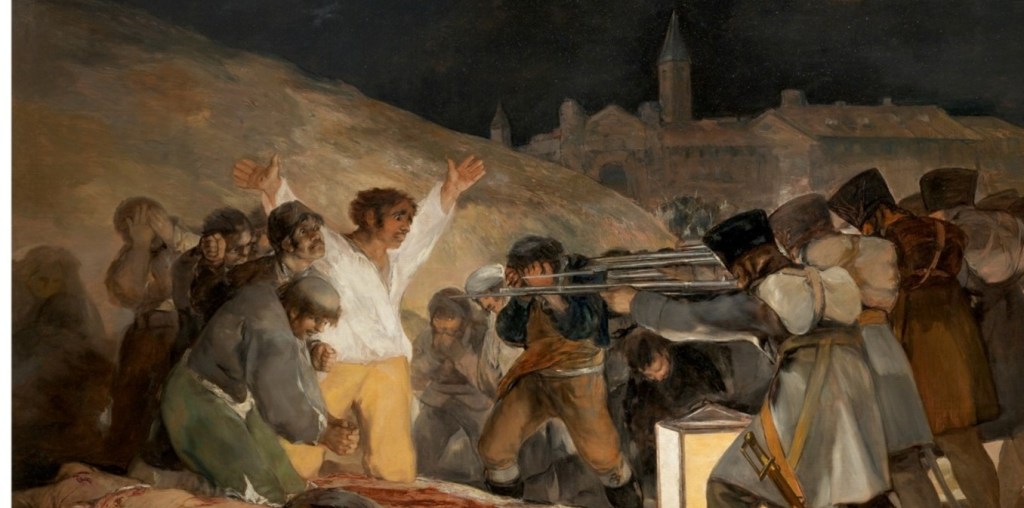
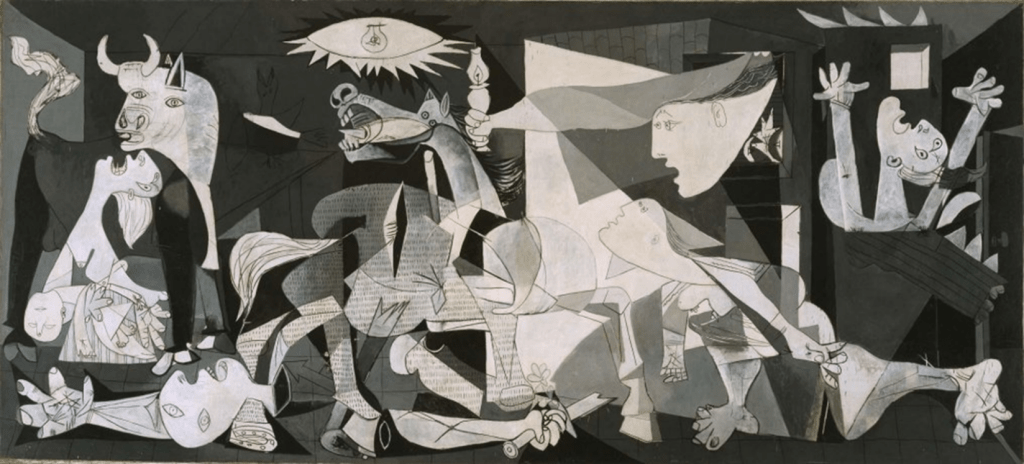
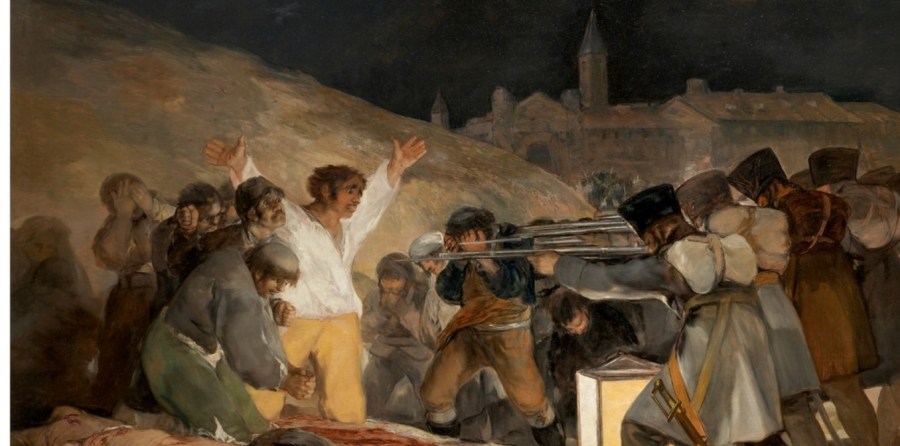
The 3rd of May 1808, painted in 1814 by Francisco José de Goya y Lucientes[1] and Guernica created by Pablo Picasso[2] in 1937, are both deeply significant works of art, the two depicting harrowing scenes of warfare in Spain. However, Goya depicts a particular event from the Napoleonic Wars: over 120 years earlier than Picasso’s of the 1937 bombing of the Basque town of the same name. Despite such a passing of time and developments in history, the two works are united over their subject of similar tragedy. Further analysis of the paintings, such as their uses of light, colour and iconography illuminates the themes and motivations for such recordings of historically significant events impacting art and society alike.
Immediately, certain formal properties can be distinguished within Goya’s and Picasso’s artwork. The two share a sense of upheld tradition in that they are two-dimensional canvas pieces. Visual, the emphasis is on the immediate effect of looking, unlike a 3-dimensional sculpture for example. This rendering to a flat, large surface suggests an attempt to produce a work to not only be observed, and perhaps from a distance due to its scale, but also to be placed upright, on a wall; Picasso was commissioned a mural specifically, and Goya’s painting for the royal collection would be presented in this fashion. They would both be secured so that they may be preserved. There is the intent to survive, to become or to mark a legacy. This is emphasised by their large scale, with The Third of May standing tall at a height of 268 cm, and a width of 347 cm. Picasso’s Guernica measures at 349cm high and 776 cm wide. The sheer size creates grandeur and affect; no doubt a representation of the subjects of the pieces, which extend much further than the physical constraints of the canvas. To stand in front of these works is to be absorbed, one must stand back far enough to physically witness the narrative as a whole, and this distance creates a feeling of reverence as the viewer creates space between themselves and the artwork, out of necessity and an element of respect.
The composition of Goya’s The Third of May is painted with oils, with careful consideration to a sense of reality. Goya employs focal shortening, with the figure on the ground, for example, laying towards us. His body interacts with the viewer. The diagonal angle at which the French soldiers to the right are stood creates further depth, adding not only to the realism of the scene, but suggesting this towering barricade of ammunition is an ongoing impenetrable force. It emphasises the victimisation of the scattered civilians to the left. The palace behind recedes into the background, rendered desolate with dark grey and browns, with a tone abandonment highlights the action in the foreground. The brushstrokes in the work are quick, rather expressionist.
And though the Romanticised scene pleads sympathy for its subject’s, Goya evidences in this loose painterly style- no doubt influenced by his predecessor Velazquez[3]– that his brushwork shifts away from a Romantic perfection. It reflects painting which captures the specific moment, and each movement with it. This is further evidenced by the title of the work, claiming a very specific day, month and year within history.
Similarly, Guernica’s composition reflects this similar sense of action through semi-abstract depiction of the amputation of limbs, disproportions, collages of light and dark areas to create a structure. Picasso overlays linear characters, the different faces and bodies directed in various ways, leading the viewers eyes to dart around the painting. However, there is definite focus on the bull and, with the other characters positioned as looking at them. Texture is added with collaging of wallpapers and emulsion paints, and sketches which remain visible on the surface.[4] There are limbs that don’t seem to belong to any one character, and it is difficult to perceive whether the scene is placed inside or outside, as the diagonal lines don’t seem to create this depth of field. This adds to the disorientation of the viewer’s gaze when looking at the chaos within the work.
These elements of composition link next to the powerful control and manipulation of light in both paintings. For example, in the Third of May the only light source is that of the lantern at the foot of the French soldiers, illuminating the victims to the left and particularly the man in the white shirt and tan trousers. Goya’s use of Chiaroscuro adds drama and contrast; the light focuses attention immediately on these civilians who have been executed and lay dead, and the man standing with arms outstretched in surrender to his fate. In Guernica, this same focalisation is created by control of light: the eye which looms above the scene suggests the presence of this illumination. The manmade bulb in place of the eye’s iris is provocative iconography, referencing the overhead bombing, and technology in warfare. The torch held by the figure emerging from the dark grey areas is the main source of light in the work, forming a triangle of light in the painting. As the characters rely on the source of light to illuminate the events below in order for it to be decipherable, it suggests a responsibility of the viewer and the artist to shed light on and understand this difficult subject matter. It is an abstracted view of reality which distorts figures and faces, and removes a normalised sense of space, to the point where it is difficult to locate or situate the work. Ambiguous in whether it is day or night, indoor or outside which adds to the effect of a chaotic and distorted scene. There is no real sense of time, as suggested by the contrast of dark and light in such close proximity to each other, and the background diagonal lines create the possible illusion of a ceiling. This chaos is representative of the subject, emphasised by the woman to the far right of the painting, who appears to be engulfed in flames: fires burned for three days after the bombing in Guernica.
Light impacts details such as colour and tonality. For example, in The Third of May, the man upon whom the light is focused wears white- a symbol of purity and echo of his innocence- and his skin and colouring are clearly depicted. In this detail there is an indent in the palms of the man’s hands, similar to that of Jesus’ wounds, or ‘Stigmata’ during his Crucifixion[5], reiterating the innocence of the man in white. Furthermore, the faces of he and his fellow citizens are illuminated and turned towards the viewer, therefore given individual identities. However, the French soldiers are all alike: the same stance, colouring and turned facing away, facial features are ambiguous. Unlike their weapons, which are rendered in great detail. Detail of the executioners also focuses on uniforms: formal and rigid. As is their arrangement: heavy, austere, grey and black. This contrasts the loose-fitting, naturalistic dress of the condemned man and those who lay slain across the ground, bleeding vivid red blood. The red and warmth of colour creates empathy for these people, to show patriotism, as this warmth and imperfection of dress humanises them in comparison to the dark greys and black with which the foreign soldiers are painted. The Third of May’s pigmentation is strong but is of a limited palette of earth tones, with the exception of those red trails of blood. Guernica is also of a limited palette: the shapes are decipherable as human and animal figures, though comprises of cool toned blue and grey colours. Picasso began to create the mural after seeing the black and white photos of Paris’ media coverage of the bombing, the pain in these photographs is portrayed for example through the silent screams of the mother, horse and outstretched hands. In Goya’s Third of May the crying mother holding her child, to the left of the painting is also portrayed in Guernica and suggests Goya’s influence on Picasso’s work. Other elements of iconography is Picasso’s inclusion of domesticated animals – the horse and the bull which are typically used by humans for agriculture and farming suggest the animals’ presence in the town, as it was bombed and the animals’ suffering is too by the hands of men.
Significant context of the two artworks is also a consideration of the artists’ motivations. The Third of May was created in 1814, six years after the event. “Goya did not paint his picture in 1808, his imagination fired by recent atrocity”- unlike Picasso’s immediate production of Guernica in response to the news headlines. Instead, Goya waited and tactically suggested this commission to the restored Spanish monarchy in 1814, requesting that he may record, “our glorious insurrection against the tyrant of Europe.”[6] Moreover, as Goya had produced portraits of French nationals during Napoleon’s reign, it could be argued that he intended to clear suspicions of his collaboration with the French, with the Second and Third of May. Goya’s artistic and social impact was surely better served as a seemingly neutral figure during changing leaderships: to remain able to critique generally, rather than claim allegiance to a deposed party, essentially lowering himself to the mercy of he who held the power, and the gun. Perhaps Goya’s self-conflict is reflected in the bowed head of the man, witnessing the execution, and his fellow onlookers, who refuse to watch.
This could suggest a neutrality perceived as cowardness: heads are hung, eyes averted, in shame of their reluctancy to intervene or aid their fellow countrymen being murdered. But again, they are unarmed. They are ill equipped to deal with such a force as Napoleon It did mark the overthrow of Napoleon in Spain, however, and called to an era of enlightenment, with its painterly loose brushwork, and unusually graphic and gruesome scene. The painting’s placement next to its counter-work The Second of May 1808, 1814, and other conflicts, brings into consideration the familiarity of today’s society with images of bloodshed, standing in the gallery immersed in it. It considers how the shocking bloodshed was received in a pre-photographic era, before the constant desensitisation from imagery in the media.
As Picasso and contemporaries pioneered the Cubist movement, his creation of Guernica recorded another major but much darker development, which redefined warfare in the modern world: the bombing of Guernica was not only significant because of the destruction of the town and the lives lost, but it was “the first total destruction of an undefended civilian target by aerial bombardment.”[7] The Spanish Civil war from 1936 to 1939 is “burned into the European consciousness” foreshadowing the onslaught of Total war, a horrific form of modern warfare. In Guernica, Picasso paints his patriotism (from afar) and empathy of the strategized suffering of innocent citizens.
The legacies of both artworks were established shortly after their creations: Goya’s being held by the Royal Collection, Madrid, 1814; and entered the Prado Museum, before 1834. It’s presence in the Prado National Gallery in Madrid asserts its position as a vital memory in Spain’s cultural history. In this same ‘canonisation’ of significance, Guernica is placed centrally in Room 206.6 at the Reina Sofia, reflecting the artwork’s significance in 20th century history both the gallery’s value of the artwork. The tapestry created by Jacqueline de la Baume Dürrbach[8] of Guernica now hangs high in the United Nations, an image of terror shown as a reminder, a symbol for peace. Both The Third of May and Guernica capture Spanish civilians’ suffering due to vicious international relations, and the continuous inhumane treatment of one’s fellow man, though over a century apart.
Bibliography:
Baudelaire, Charles. Curiosités esthétiques. Paris: Michel Levy, 1860. Translated by Jonathan Mayne as Art in Paris 1845-1862. Oxford: Phaidon, 1965.
Berger, John (1965). The Success and Failure of Picasso. Penguin Books, Ltd. p. 175. ISBN 978-0-679-73725-4
Fremont-Barnes, Gregory. The Napoleonic Wars: The Peninsular War 1807-1814 (Essential Histories). 1st ed. Oxford: Osprey Publishing, 2002.
Hughes, Robert. Goya. London: The Harvill Press, 2003.
Hughes, Robert. “The Artist Pablo Picasso.” Time, June 8, 1998. http://content.time.com/time/magazine/article/0,9171,988489-1,00.html. Accessed 25 March 2020
Editorial, “In Praise of … Guernica.” The Guardian, March 26, 2009. https://www.theguardian.com/commentisfree/2009/mar/26/pablo-picasso-guernica-spain-war.
Murray, Christopher. “The Third of May 1808-1814”, in Encyclopedia of the Romantic Era, 1760-1850. New York: Taylor and Francis, 2004. pp. 1133–1134
Preston, Paul. The Spanish Civil War: Reaction, Revolution and Revenge. London: Harper Collins, 2006.
Thomas, Hugh. Goya: Third of May 1808. Illustrated. University of Michigan: Viking Press, 1973.
Higgins, Charlotte. “Picasso nearly risked his reputation for Franco exhibition.” The Guardian. UK: Guardian News and Media (28 May 2010). https://www.theguardian.com/artanddesign/2010/may/28/picasso-franco-exhibition Accessed 27 March 2020.
Philip Delves Broughton, “Picasso not the patriot he painted”, The Sydney Morning Herald, 19 May 2003. Accessed 25 March 2020
https://www.museoreinasofia.es/en/collection/artwork/guernica
https://guernica.museoreinasofia.es/en#introduccion
https://www.theguardian.com/artanddesign/2015/oct/04/goya-in-hell-national-gallery-portraits
[1] The 3rd of May 1808 in Madrid, or “The Executions” GOYA Y LUCIENTES, FRANCISCO DE. Copyright ©Museo Nacional del Prado (subsequently referred to as Third of May within the essay).
[2] Guernica, 1937, Pablo Picasso.
[3] Velazquez, influence of Goya’s style.
[4] https://guernica.museoreinasofia.es/en#introduccion
[5] Hugh Thomas. 1972. Goya: The Third of May 1808.
[6] Christopher Murray Encyclopedia of the Romantic Era, pp.33
[7] Robert Hughes, Goya.
[8] Editorial, “In Praise of … Guernica.” The Guardian, March 26, 2009. https://www.theguardian.com/commentisfree/2009/mar/26/pablo-picasso-guernica-spain-war.Advertisements
 LAURA ROZAMUNDA